Adidas Cracks 100 Grams: Inside the Pro Evo 3, the Shoe Behind London's Sub-2
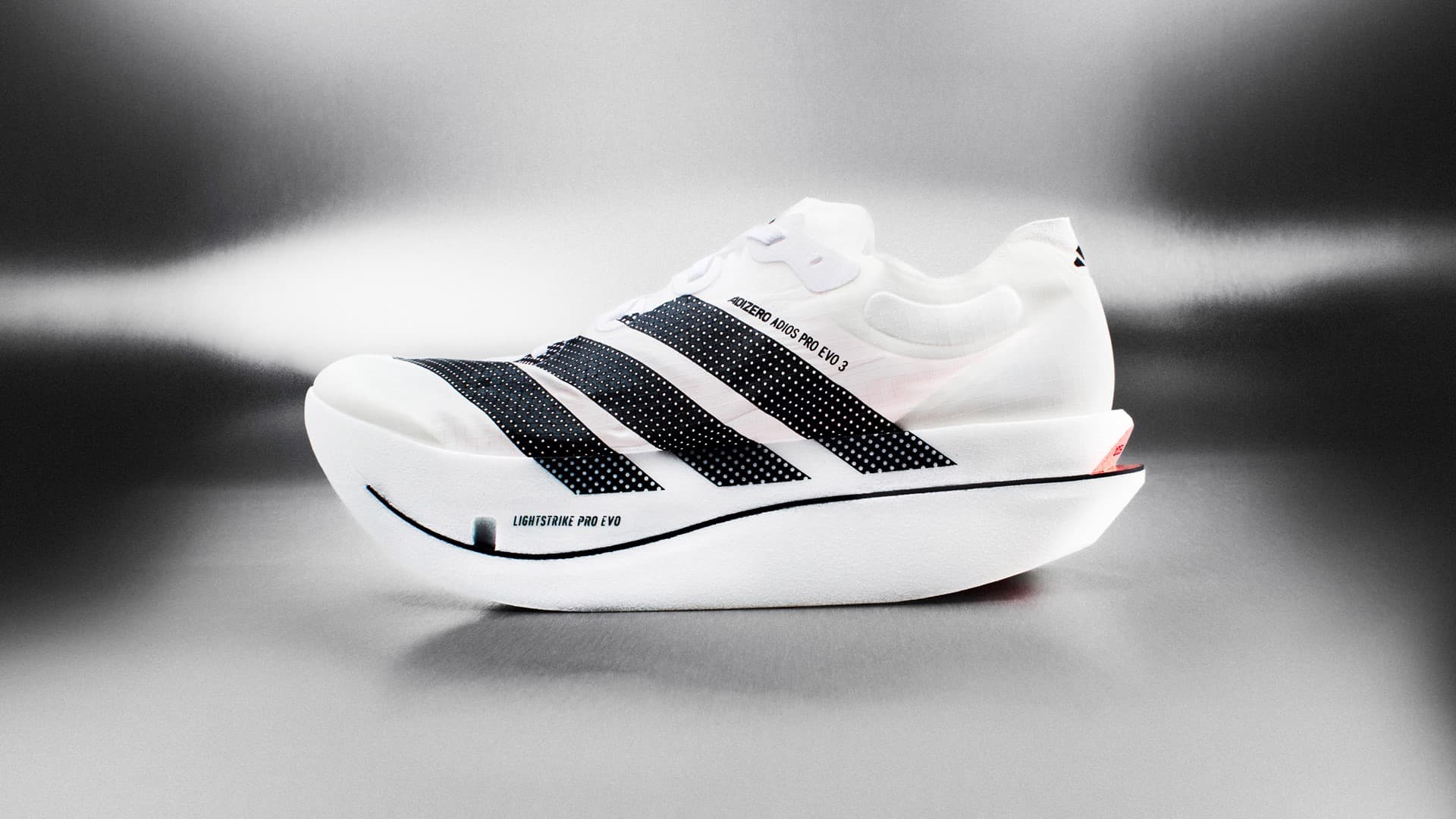
Adidas dropped its first sub-100-gram marathon racer, the Adizero Adios Pro Evo 3, on April 25. Two days later, Sabastian Sawe wore it to run 1:59:30 in London. We unpack the 97g build, the $500 price tag, and why it'll be near-impossible to buy.
What happened
On April 25, 2026, adidas quietly released the Adizero Adios Pro Evo 3 in a limited drop on adidas.com and at a handful of specialty retailers. Forty-eight hours later, Sabastian Sawe wore the same shoe to run 1:59:30 at the London Marathon, becoming the first man to break two hours in a record-eligible marathon. Tigst Assefa wore it too, on her way to a women-only world record of 2:15:41. Two world records, two days after launch. All at a price most runners will never pay, in a stock most runners will never see.
The 97-gram milestone
The Pro Evo 3 weighs 97 grams in a UK 8.5, making it adidas' first sub-100-gram racing shoe and, as far as the brand is willing to say, the lightest fully-stacked carbon-plated marathon shoe in the world. For comparison, the Pro Evo 2 it replaces came in around 138 grams. Nike's Alphafly 3 sits closer to 200. Asics' Metaspeed Sky Paris is similar.
The weight saving comes from three places:
- Lightstrike Pro Evo foam: a new generation of adidas' supercritical PEBA-based midsole that the brand says is roughly 50% lighter than the foam in the Pro Evo 2, with no loss in energy return.
- ENERGYGRIM: a redesigned carbon plate system that replaces the Energy Rods used in earlier Pro Evos. Adidas claims 11% more forefoot energy return vs. the Pro Evo 2.
- A barely-there upper: a translucent monomesh that disappears on the foot.
Stack height is 39mm at the heel, 36mm at the forefoot, a 3mm drop, right at the World Athletics 40mm legal ceiling. Net effect, by adidas' own numbers: 30% lighter than the Pro Evo 2, with a 1.6% improvement in running economy.
Built for one purpose
This is not a shoe meant to last. The Pro Evo 3 is engineered for a single race-day effort: there's no rubber on most of the outsole, the upper is paper-thin, and adidas itself markets it as a "race-day specialist." Reviewers are already reporting that the foam shows wear after a single marathon. At $500 a pair, the per-mile cost is the kind of number that only makes sense if you're chasing a personal best you've trained two years for, or a sub-2 marathon contract bonus.
The shoe also sits at the sharp end of the running-economy curve. The 1.6% efficiency claim is meaningful at elite paces (it's worth roughly a minute over the marathon for a 2:05 runner), but the same shoe under a 4:30 marathoner won't return the same numbers, because the foam and plate were tuned for high-cadence, high-force foot strikes.
Good luck buying a pair
The April 25 drop was tiny. Most US and EU specialty retailers received pairs only in single-digit quantities; the adidas.com release sold through within minutes. A wider release is planned for the fall 2026 marathon season (Berlin, Chicago and New York), but adidas has indicated it will again be production-limited rather than a true general release.
For most beginners and recreational runners, the Pro Evo 3 will live where the original 2023 Pro Evo did: as a halo product worn on TV at major marathons, not in everyday training rotations. The trickle-down of lighter foams, simpler plates and sharper geometries is what eventually reaches the adidas Boston and Adizero SL lines, and that's where the 97-gram milestone matters for the rest of us.
The bigger picture
The Pro Evo 3 is the latest move in a super-shoe arms race that started with Nike's Vaporfly in 2017, redrew World Athletics' rulebook, and has now produced a sub-2-hour marathon inside the rules. Where it goes from here is a more interesting question than how light shoes can get. The 40mm stack ceiling is fixed. The foam is approaching the limits of how light a marathon-distance midsole can be without collapsing. The next gains will come from places we haven't seen yet (plate geometry, lacing pressure, fit-specific tuning) and from the slow trickle of all this technology into shoes that don't cost $500 and don't sell out in three minutes.
For now, the headline is simple. Adidas built a 97-gram race shoe, two of its athletes wore it to set world records two days later, and every other brand in the room just got a new bar to clear.