Gold to Vic Clapham: The Comrades Medals and What Each One Means
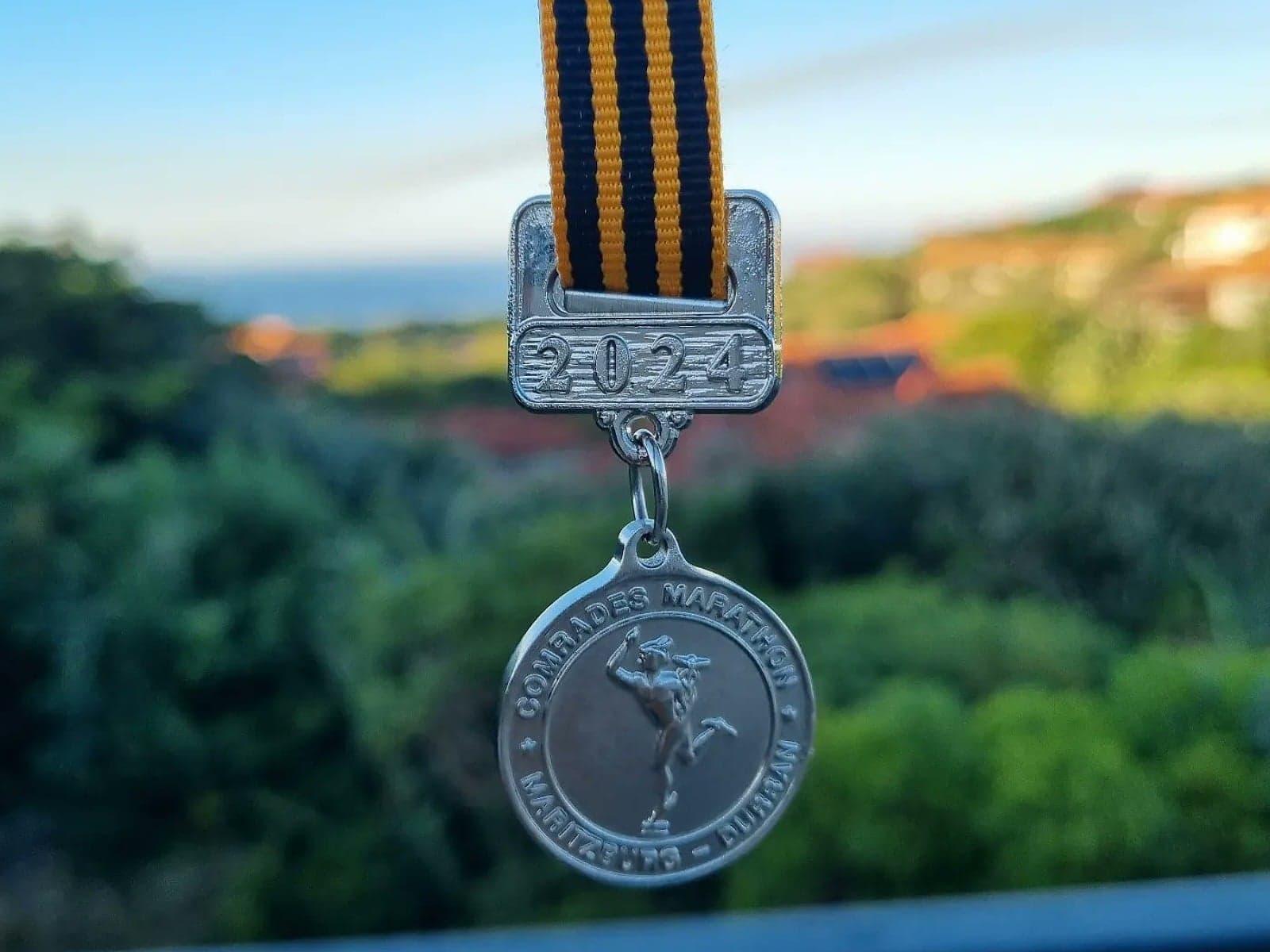
The Comrades Marathon hands out nine different medals, each tied to a finishing time, and most are named after a person who changed the race. Here's the full ladder, from the gold reserved for the first ten to the Vic Clapham earned by beating the final gun, and the story behind each one.
The idea
At most races, a medal is a medal: everyone who crosses the line gets the same one. Comrades does it differently. The time you finish in decides the medal you take home, and there are nine of them. A runner who finishes in 5:59 and one who finishes in 11:59 have both conquered the Ultimate Human Race, but they wear different metal to prove it, and that is the entire point. The medal ladder turns one finish line into a dozen different goals.
Most of the medals are named after someone who shaped the race. Knowing the names is half of understanding Comrades. Here's the full ladder, hardest to earn at the top.
Gold: the first ten
The Gold medal goes to the first ten finishers, men and women, scored separately. This is the rarest medal at Comrades and effectively the professional tier: these are the athletes fighting for the title and the prize money. First awarded in 1931 (to the top six back then, expanded to ten in 1972), it's the medal the likes of George Kusche and Gerda Steyn collected on this year's up run.
Wally Hayward & Isavel Roche-Kelly: the sub-elite
Below the gold tier sit two medals for the runners who are exceptional but just outside the top ten.
- Wally Hayward medal (men): 11th place to a finish under 6:00:00. Named for one of the greatest names in the race's history: a five-time champion who, astonishingly, came back at age 80 to finish inside the cutoff in 10:58. The medal is half silver, half gold, which suits a man who lived at both ends of the field.
- Isavel Roche-Kelly medal (women): 11th place to a finish under 7:30:00. Introduced in 2019, it honours the first woman to break 7:30 at Comrades, back in 1980. It gives the fastest non-podium women a medal of their own rather than folding them into the men's standard.
Silver: the old standard
The Silver medal is awarded to men finishing between 6:00:00 and 7:29:59. It's the oldest medal at the race: in 1921 every finisher received silver, and for a decade it was the only medal there was. Today it marks a genuinely fast amateur: comfortably under six minutes per kilometre for the whole 85-90 km. For a huge number of club runners, "going for silver" is the dream that defines a season.
Bill Rowan: the sub-9
The Bill Rowan medal covers 7:30:00 to 8:59:59, and it carries a lovely piece of symmetry. Bill Rowan won the very first Comrades in 1921 in a time of 8:59, so the medal named after him is awarded to anyone who matches the inaugural champion by breaking nine hours. Introduced in 2000, it's bronze-centred with a silver ring, and for many mid-pack runners it's the most coveted target on the whole ladder: proof you beat the original winner's time.
Robert Mtshali: the sub-10
The Robert Mtshali medal is for finishes between 9:00:00 and 9:59:59. It's the newest of the named medals, added in 2019, and the name matters. Robert Mtshali was the first Black athlete to run Comrades, finishing unofficially in 1935, four decades before the race was formally opened to all runners in 1975. The medal corrects a long silence in the race's history and gives the sub-10 band a name worth knowing.
Bronze & Vic Clapham: the final hours
The last two medals belong to the runners the whole country tunes in to watch.
- Bronze medal: 10:00:00 to 10:59:59. First introduced in 1972, it's the medal of the determined back-of-pack runner holding off the clock.
- Vic Clapham medal: 11:00:00 to 11:59:59: the final hour, the hardest-won medal of all. It's named after Vic Clapham, the World War I veteran who founded Comrades in 1921 as a living memorial to fallen soldiers. Beating the 12-hour gun for this medal (often with seconds to spare as the final cutoff is enforced mid-stride) is the most dramatic finish in the sport.
The back-to-back medal
There's one medal that has nothing to do with speed. The Back-to-Back medal, introduced in 2005, goes to novices who complete two consecutive Comrades: a down run and an up run in successive years. Because the route alternates direction each year, finishing both means you've run the full course in both directions: the complete Comrades experience. It rewards the one thing the race values most: coming back.
Why it matters for the rest of us
Here's the part that should land if you're newer to running: Comrades built a goal for every level of runner. You don't have to be chasing gold to have something real to aim at. Sub-12 and a Vic Clapham is a mountain of an achievement. Sub-9 and a Bill Rowan is a multi-year project. The medal ladder is just a structured way of saying get a little fitter, and there's a next rung waiting.
That's exactly how progress works at every distance. Nobody starts at silver: they start with a first 5K and years of consistency, the same idea our guides are built around. If the medals lit something up, you don't have to start at 85 km: find a race near you and earn your own first finish line.
And if you watched this year's up run, where Kusche shattered the 18-year record and Steyn took a fifth title, remember that every one of those gold medallists once stood on a start line with nothing on their wall at all.